
It’s been a little while since I last posted, and I just realized with some dismay today that I actually neglected to mark the two-year anniversary of having started this way of life three days ago! So: time for a post, definitely! A colleague of mine suggested a topic, given how common it is for people to start trying to lose weight in January. She suggested that I write a post debunking some of the most persistent weight loss myths out there, based on what I’ve encountered, read in junk science “articles”, and what I know to be true as a discipline of Dr. Jason Fung’s methods, research, and proven clinical experience. So here goes:
You can lose weight through exercise alone. This is a big one. I used to believe it myself, despite the fact that no evidence ever backed it up, at least not for me. In my pre-weight loss life, I was always pretty active. I walked around 3 km per day, swam laps once or twice per week – but I just kept gaining weight. We know for a fact that the calories in vs. calories out theory is deeply flawed (more about that in a second!), but even if it weren’t, you would have to exercise so, so much and eat so very little to keep this balance in check. Let’s imagine that you could sustain a lifestyle of only consuming, say, 1,000 calories per day. That’s not very much, and literally no one has ever managed to do this. It’s not a great plan, anyway – it leads to massive cheats, binge eating, eating disorders, and constant feelings of deprivation on the mental health side of it, and on the strictly physical, it also leads to slower metabolism, constant feelings of cold and fatigue, and as a lifestyle pattern becomes yo-yo dieting and weight gain. But even let’s say that this life of lettuce and sadness actually worked for anyone in the first place, you would still have to exercise constantly to keep the weight off. I’m lucky in the sense that I have a job that allows me to walk a lot, rather than sitting all day. Let’s consider my day yesterday: between walking around the museum’s galleries in the course of my day, running an errand or two, and walking to a choir rehearsal, I clocked 16 km of walking. That burned about 303 calories, according to my tracker. Add the high intensity interval training cardio I did in the morning and that gives me another 370 calories or so burned, totalling in 673. I literally walked all day on top of having worked out at a high level of intensity and burned far fewer than 1,000 calories. It can’t be done. Even if this very low calorie way of eating were a good choice (which it isn’t) in the first place, no one could sustainably keep their caloric intake lower than their caloric burn.
It’s all about calories. It isn’t. It just isn’t. For one thing, calories are a useless form of measurement. What we need to consider is the effect the food we’re eating has on our bodies, specifically on the hormonal response produced. 100 calories of broccoli is not going to have the same impact as 100 calories of cake. On top of that, if you were following a 1,000 calorie/day way of eating, you could easily fill your 1,000 calories with absolute garbage, risking serious nutrient deficiency and still producing a high insulin response. Insulin is a fat-storing hormone. If we eat foods that trigger a high insulin response, weight gain will be inevitable. It’s not about calories, because not all calories are equivalent to one another. It’s about the response produced.
We need carbs to live. This is one that I see a lot on those junk science websites, or cited by celebrity dieticians. First off, we don’t. Period. Of the three macronutrients (protein, fat, and carbohydrates), only protein and fat are necessary for us to live. Secondly, not all carbs are equal, either. Carbs come in a few forms, the two main ones being:
- Refined carbs (or simple): these are the ones that have had their fibres stripped away, or have been pulverized or liquified. Think flour, juice, etc. Sugar in all of its varied forms (honey, molasses, glucose, corn syrup, coconut sugar, dextrose, etc etc) falls into this category, too. There is almost nothing redeeming about these ones apart from the fact that these can be processed very quickly and made into blood glucose for energy. However, the faster they’re processed, the higher the insulin response will be. Hence, liquids and powders are the worst, especially if they’re sweet. Fruit juice is not our friend (alas!). Bottom line: if it’s sweet (doesn’t matter what sort of sweet – our bodies can’t tell the difference!) or absorbs quickly, it will result in a high insulin response.
- Unrefined carbs (or complex): these are the ones that have been left whole. Whole grains, vegetables, fruit, legumes, nuts, seeds, in other words.
Let’s revisit the “we need carbs to live” business. These same celebrity dieticians like to rail against the notion of cutting out an entire category of food and go off about how we’ll all become nutrient deficient and die of scurvy if we deny ourselves these life-sustaining carbohydrates. What I have to say to this comes in two parts:
- No one ever said to cut ALL of the carbs. I’ve never told anyone to cut out leafy greens, cruciferous vegetables, berries, cucumbers, tomatoes, mushrooms, nuts, or seeds. We need vegetables in particular for their fibre and their micronutrients (vitamins & minerals). We don’t need to eat grains to get fibre from them, and if we’re eating our grains in the form of flour, we’re not getting it, anyway. Yes, even “whole wheat” flour. If you’re eating whole wheat berries, okay. But it’s still not necessary.
- Here’s the second part of my counter-argument: just because it’s easiest for our bodies to make blood glucose from simple carbs doesn’t mean that it’s the only way, or even the best way. It’s just the fastest way. Our bodies are also capable of making blood glucose from carbs with their fibres still attach, which helps them to absorb more slowly and also prevents some of it from being absorbed at all, depending on the type of fibre. Usually these articles cite unrefined carbs as being preferable for this reason. However, that’s still not the only way we can get blood glucose: our bodies can also produce it from our own stored fat, if we allow ourselves to enter a state of ketosis. The serious bonus of this is that our fat also stores micronutrients, so if you’re fasting in hopes of entering ketosis, there’s no risk of becoming nutrient deficient just because you’re not eating factory-made “fibre rich” cereal (aka factory floor sweepings).
So, no: we don’t need carbs to live. However, certain carbs are fantastic and we should absolutely eat them! We just don’t need to be eating high-starch foods like grains, legumes, and fruit. You’re better off sticking with lower carb veggies like broccoli, cauliflower, green beans, asparagus, celery, mushrooms, spinach, arugula, brussels sprouts, zucchini, eggplant, spaghetti squash, tomatoes, avocadoes, cabbage, swiss chard, lettuce, berries, nuts (except for peanuts; they’re a legume!), and seeds. Leave out the underground veggies, plus corn and peas, and you’re golden. There are so many options out there. No one ever died of a potato deficiency!
Everyone’s needs are the same. Obviously this one isn’t true. I’ve had people tell me that they need to eat, say, black beans because they’re a good source of fibre and protein. I love black beans, but for my personal needs, which are to limit insulin response, they’re too high in carb and I can get protein and fibre from lots of other sources. Steak will give me far more protein, and sunflower seeds will give me lots more fibre. By this standard, it’s hard to categorically state that one food is “healthy” while another isn’t, though refined sugar has no redeeming health features whatsoever. An apple can be argued to be healthy if what you’re looking for is a low calorie, low fat food source with a decent amount of calcium and vitamin C (around 10% and 8% of daily recommended intake respectively). But at 25g of carb, it’s just too high in natural sugars to warrant regular inclusion in my eating plan. As a treat or an exception, sure, but it’s not a food I would consider something to go crazy on because it’s “healthy”. It all depends on what you, personally, need. That said, no one needs certain inarguably terrible foods – diet pop, almost any processed or snack food, etc. We eat those for enjoyment and acknowledge that they’re not doing us any favours on the health front, and that’s fine. But watch out for categorical statements about the healthiness of various foods. It depends on your needs. So yes – sweet potatoes might have more redeeming nutritional value in terms of micronutrients than bread, but the carb value between one medium sweet potato and two slices of whole wheat bread are basically the same. The better choice would still be neither if you’re trying to lose weight.
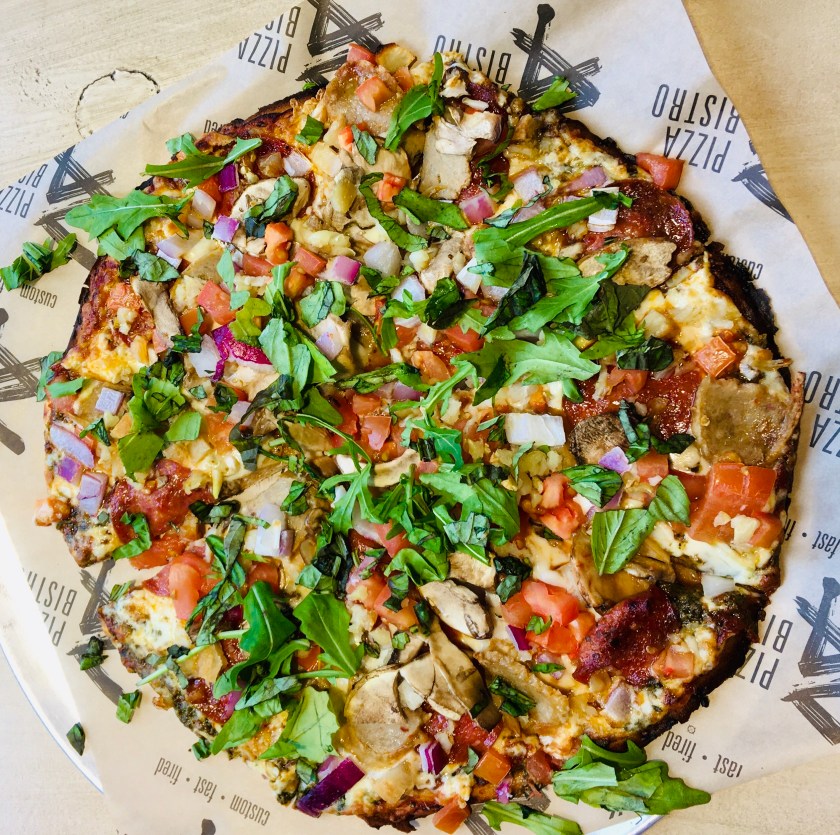
This was long and text-heavy, so let me just wrap up by sharing this photo of a cauliflower crust pizza that a local chain just started carrying! Unlike many (MANY!) cauliflower crusts out there, this one is genuinely JUST cauliflower. Do watch out – many advertised cauliflower crusts are just flour crusts that also have cauliflower, not cauliflower instead of flour! At Boston Pizza, for instance, the cauliflower crust is actually higher in carbs than the regular ones! But this pizza was fantastic! Anyway, have a healthy start to your 2020!

 The Fasting Life
A. That pizza looks amazing
B. Yes. To all of this!
LikeLiked by 1 person
The pizza is so good! The chain is called Za Pizza Bistro, and they let you do unlimited toppings, too! This bad boy has both red and pesto sauces, mozza, pepperoni, spicy sausage, chicken, tomatoes, red onion, roasted garlic, then after it was baked, they added argula and fresh basil. Amazing!!
LikeLiked by 1 person
Awesome. I just hacked my favorite pre-keto pizza not long ago. Arugula would be an amazing addition. Also, I’m fully inspired by, not only your journey (I would not be where I am now without your influence), but also in your actual posting. You inspire me to write :). Ilu
LikeLiked by 1 person
Ahhh, Ilu, you!! I’m so glad to hear this! And also, DO dish on your preferred version of making keto pizza! I’m a big proponent of the fathead and am planning to make it tomorrow night. 🙂 My version, specifically, goes to the tune of: 3/4 cup shredded mozza, 2/3 almond flour, 2 tbsp (ish) cream cheese (microwave 1 min, stir & microwave another 30 secs), add garlic powder, rosemary, oregano, and an egg, stir well. Plop onto parchment paper, put another sheet on top, roll it into a vaguely pizza-esque shape, remove top layer, bake at 425 F for 12-14 min, flip onto fresh parchment, sauce & dress the thing, bake for another 7-8 min or until the cheese is done to your liking, voilà. 🙂
LikeLiked by 1 person
Yesssss, fathead!!! I’m a coconut flour girl. I do it that way :). Spread as thin as it will go. Bake. Then, I do a tiny bit of tomato sauce seasoned with garlic and Italian spices topped with moz and spicy Italian sausage crumbles and pepperoni and bacon. Then when it’s done, scallions. Oh man. Perfection.
LikeLiked by 1 person
I am so trying to post the pic of my pizza. I am failing lol!!!
LikeLike
Sandy – with the coconut flour, you don’t find you need to add more egg/liquid at all? I’ve frequently read that almond flour can directly replace wheat/grain flour, but that for coconut flour substitutions, it’s so absorbant that it needs more egg to offset it. Have you found that at all?
LikeLike
Oh. I just follow the coconut flour method here (give me a mo to find it ): https://www.wholesomeyum.com/recipes/fathead-pizza-crust-low-carb-keto-gluten-free-nut-free/
LikeLiked by 1 person
Oh, gotcha! That makes sense! Thanks! Yeah – figured it would be different!
LikeLike
I make it suuuuuuuuuuuper thin and bake it to done before adding anything.
LikeLike
Yup, I bake mine before adding the rest, too. 🙂
LikeLiked by 1 person